New Product Launch: Employee Relationship Quality (ERQ)
Deep-Insight is delighted to launch a new Voice of the Employee service, specifically aimed at companies with 100-500 staff: Employee Relationship Quality (ERQ™).
Why 100-500 staff?
Our research shows that most companies with 1,000 or more employees have systems in place for capturing the voices of both employees and customers. That’s not the case for mid-market companies, specifically those with 100-500 employees, where many companies have no mechanism for understanding what their staff think of them.
This is a product launch that has been a couple of years in planning, and has involved a significant amount or research and discussion with HR professionals across Europe. We would specifically like to thank the following for their time and input:
Setting Up An Effective Employee Feedback Programme
So how do we set up and run an effective employee feedback programme?
Let’s start with a few basics:
Confidentiality. An effective employee feedback programme must be confidential so that employees can feel safe to speak openly and honestly. At the same time, it must deliver the level of detail and clarity required for leadership to drive meaningful change.
Methodology. We need to measure the right things for today’s employees. Today’s workplace is different – more remote working, less job security, greater tendency to ‘job hop’ and so on – and we need to reflect these changes in the work environment in the questions that we ask.
Frequency. All of our research suggests that the big annual employee survey is no longer enough. At a minimum, get feedback twice a year, or supplement an annual survey with more frequent pulse surveys on specific topics.
Deep-Insight has been capturing the voice of the employee for years but is now launching a new offering aimed specifically at this 100-500 employee market: Employee Relationship Quality (ERQ™).
ERQ is an independent and confidential way of getting employee insights that help you drive customer experience (CX) in your organisation. The ERQ model is based on eight drivers and takes into consideration the challenges of today’s world and aims to understand if your teams are set up for success. For example, it takes a close look at employees’ Wellbeing by measuring if they can maintain a sustainable work-life balance and if they feel a sense of job security. It also adds includes questions around Success and Support.
These eight drivers are all critical components of the current-day employee relationship.
The Eight Drivers of Employee Relationship Quality
Today’s employer-employee relationships can be complex, so we need to analyse how well we are doing on eight different dimensions:
BENEFITS aims to understand if you as an organisation are meeting your employee’s basic needs. It looks at the following sub-drivers: Pay and Opportunities.
SUPPORT aims to understand if you are offering your employees the required guidance and training to do their job. It looks at the following sub-drivers: Onboarding, Development and Environment.
SUCCESS looks at if your employees have the tools required to do their job and if they feel a sense of agency over their role. Sub-drivers of success are: Agency and Satisfaction.
WELLBEING aims to understand if your employees are satisfied with the work-life balance provided and if they feel a sense of teamwork and appreciation. It’s sub-drivers are: Work-Life Balance, Collaboration and Job-Security.
CULTURE aims to understand if you provide your employees with a respectful and safe working environment. The sub-drivers of culture are: Safety, Respect and Inclusion.
TRUST aims to understand if your employees feel a sense of trust and if they feel like they are being treated fairly, with honesty and integrity. The sub-drivers are: Honesty, Integrity and Fairness.
COMMITMENT looks to understand if your employees feel proud to be a part of your organisation and a sense of loyalty to stay with you long-term. The sub-drivers are Pride and Loyalty.
CUSTOMER FOCUS aims to understand if your employees see your organisation as one that puts its customers first. The sub-drivers are Customer Care, Reliability and Responsiveness.
Interested?
If you would like to set up an Employee Relationship Quality (ERQ) programme, we’d love to talk!
Peter Whitelaw and I wrote a book last year called Customer at the Heart. It was a fun experience interviewing CEOs and sales directors from large B2B companies across Europe and Australia.
One of the consistent messages we heard in those interviews was the importance of investing in the ‘Soft Side’. In other words, focusing on people as much as on process.
This is a really important point: if you are responsible for running a customer experience (CX) programme in your organisation, don’t under-estimate the importance of investing in ‘Soft Side’ activities if you want to generate real long-lasting results.
This means spending significant amounts of time with both your leadership and client-facing teams planning for success.
The Importance of Investing in the ‘Soft Side’
A quick recap on the four quadrants in the Customer at the Heart model before we go any further:
1. LEADERSHIP. The most important quadrant. Good Customer Experience (CX) programmes are ALWAYS led from the top
2. STRATEGY. Good CX programmes link customer, product, operational and organisational strategy explicitly to customer needs
3. EXECUTION. Success requires properly resourced CX teams that are brilliant at executing the Strategy
4. CULTURE. Finally, Customer Excellence must become integral to the DNA of the organisation: “it’s how we do things around here”
All four quadrants are necessary for a successful CX programme. The ‘Hard Side’ quadrants of Strategy and Execution are all about metrics and processes. ‘Hard Side’ activities lend themselves to key performance indicators (KPIs) and while the activities in these two quadrants are important and easily measurable, the quadrants of Leadership and Culture are actually more critical.
In our experience, Leadership is the most important quadrant while Culture is the most challenging. And yet, here’s the strange thing: in most CX programmes the ‘Soft Side’ is often overlooked and almost always under-resourced.
Our Approach
We have a different approach at Deep-Insight. We spend a lot more time with leadership teams and sales or account teams BEFORE we think about asking our customer’s clients for their views. If you want to run a customer survey in a hurry – “I need to get the results back by the end of the month…” – we’re probably not the organisation for you.
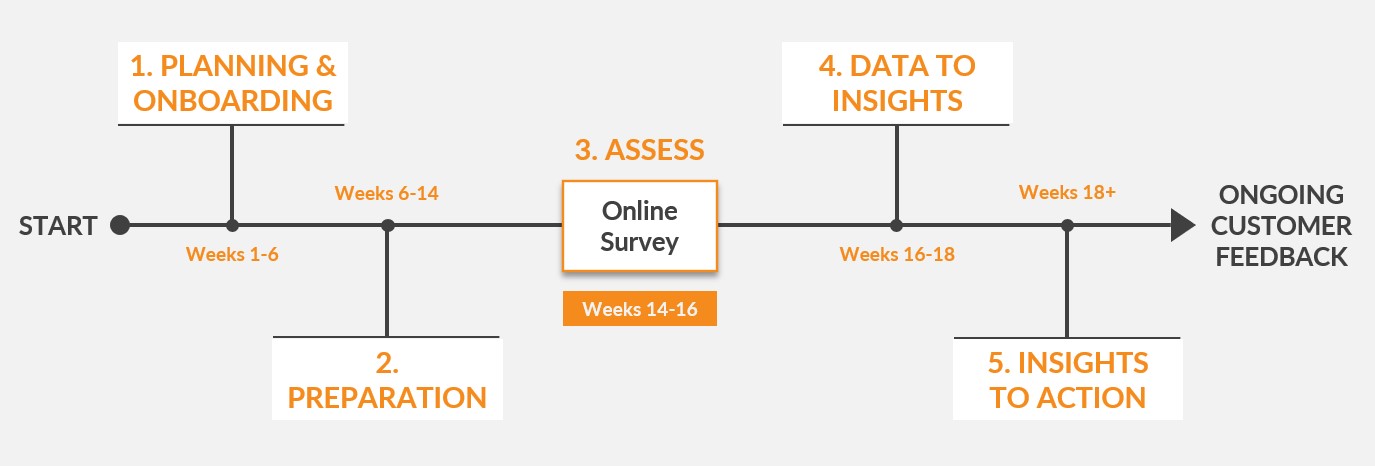
At Deep-Insight, the first 14-16 weeks of our process are critical and must be done properly. If you don’t invest the time up-front, your CX programme will not deliver the results that Management and the Board expect from it. More than likely, it will end in failure. It’s as simple as that.
Planning & Onboarding
The first phase in our approach is ‘Onboarding’ the organisation; The very first step is to secure the buy-in from the senior leadership team to the journey that they are about to embark on. And it is a journey because cultural change takes time. The second step is to onboard the rest of the organisation, primarily the sales and account teams. They own the customer relationships and if they don’t embrace the programme with gusto, the entire programme is at risk of being seen as a box-ticking exercise.
We typically work with dispersed sales and service teams in online workshops, and always with senior leadership support and involvement. These onboarding workshops are critical to driving up response rates and completion rates, as well as delivering action and improvements.
Insights to Action
The final phase is where the rubber hits the road. The online survey is complete. We have gathered some key insights from the feedback. Now it’s time to assemble the sales and account teams again. This time the focus is on their role in ‘Closing the Loop’ with the client. This is arguably the most critical part of the entire process. The account manager – sometimes with a member of the senior leadership team – must meet the client to discuss the feedback from all individuals in that client’s organisation.
In many cases, these discussions are straightforward because everything is fine and the relationship is on an even keel. In some instances, the client may be a ‘Stalker’ or an ‘Opponent’ and a much tougher and more honest conversation is needed.
The key outcome of these ‘Close the Loop’ meetings is agreement on the appropriate actions that are needed to improve and deepen the relationship. This gets built into the Account Planning process for that client.
Investing in the ‘Soft Side’
If your CX programme isn’t working the way you hoped it would, it’s probably because you’ve under-invested in the Leadership and Culture quadrants. The symptoms will be clear: disengaged account teams; limited insights; complete absence of action.
If you notice any of these symptoms in your CX programme, do get in touch.