Why Most Acquisitions Fail

Why Most Acquisitions Fail


Why Most Acquisitions Fail (And What To Do About It)

I recently spoke with the Strategy Director of a global, billion-dollar services company about a potential acquisition they were considering. Our conversation soon shifted to the broader topic of acquisitions—why so many fail, and why the Commercial Due Diligence (CDD) process that many companies rely on is often not fit for purpose.

Every year, billions are spent on mergers and acquisitions (M&A), with boards and executives persuaded that acquisitions are the fastest path to growth. Yet despite the enthusiasm, the evidence is sobering: research consistently shows that 60–90% of acquisitions fail to deliver on their original objectives. In most cases, a significant amount of shareholder value is destroyed.

So why does this happen so often, and what can business leaders do differently to avoid becoming another statistic?

The Synergy Trap

Mark Sirower knows a thing or two about M&A failures.

Sirower is a partner in Deloitte Consulting’s M&A practice and his book The Synergy Trap remains one of the most enduring analyses of why acquisitions destroy rather than create value. His central insight is straightforward: to win control of a target, acquirers must pay a premium, often 30–50% above market value. The only way to justify that premium is by delivering synergies — additional value that would not exist without the merger.

But those synergies are rarely realised. Executives tend to overestimate cross-selling opportunities, underestimate integration costs, and ignore the hidden risks of cultural misalignment. Competitors do not sit still, often targeting unsettled customers during the transition. Meanwhile, management focus is diluted as leaders wrestle with integration instead of driving the core business.

As Sirower puts it: synergies are easy to promise, but hard to deliver. And because acquirers must pay a premium up front, even modest under-performance can quickly turn a deal into a value-destroying exercise. Sirower also confirms that “fully 65 percent of major strategic acquisitions have been failures.” 

So do your homework before you but a company. The technical term for that homework is due diligence and it covers a multitude of activities – financial, legal, operational and commercial.


The Under-Appreciated Role of Customer Due Diligence

One area of commercial due diligence deserves far more attention than it usually receives: Customer Due Diligence (CDD).

In business-to-business (B2B) markets, the real value of an acquisition lies in its future revenue streams — often concentrated among a surprisingly small client base. Many billion-dollar companies derive more than half their revenues from fewer than 500 customers, and sometimes fewer than 100.

Yet acquirers rarely probe this customer base with sufficient depth. In some cases, a few senior executives might meet a handful of clients, ask if they are satisfied, and whether they expect to buy more in the future. While useful, these anecdotes are not enough. They are often biased, rarely benchmarked, and lack independence.

Robust CDD requires more. It means engaging systematically with the clients that generate the most revenues. It means hearing not just from the main contact but also from decision-makers, influencers, and end users. And it means using structured methodologies to uncover not only current satisfaction but also future buying intentions, perceptions of value, and risks of defection.

My study reveals that fully 65 percent of major strategic acquisitions have been failures


Questions Every Board Should Be Asking

When reviewing the due diligence on a target company, boards and executives should challenge whether the process has delivered real insight into the customer base that is being acquired. Three questions are critical:

  1. Are we speaking to the right customers? Do the voices represented account for at least 50% of total revenues? Are multiple perspectives captured within each client relationship – key decision makers, influencers, and operational contacts?
  2. Are we hearing the true Voice of the Customer? Were customers selected independently, or hand-picked to present a flattering view? Are responses benchmarked against peers to provide context? 
  3. Are we asking the right questions? Does the analysis go beyond satisfaction to address loyalty, growth potential, and perceptions of value for money? Basically, do we know if these customers are going to stay or leave?

Only with these insights can business leaders form a credible view of revenue sustainability and growth potential — the foundations of any acquisition’s value.


Avoiding the Pitfalls

The lesson from decades of research and practice is clear: acquisitions rarely fail because of weak financial models. They fail because assumptions about customers, markets, and integration prove unrealistic.

Boards and executives must therefore insist on rigorous, independent, and customer-centric due diligence. Without it, the risk of falling into the “synergy trap” remains high. With it, leaders at least give themselves a fighting chance to deliver on the promises that justify the premium paid.

Acquisitions will always carry risk. But with disciplined valuation and a much sharper focus on customers — the true engine of future revenues — companies can tilt the odds away from failure and toward lasting value creation. So do your homework – and in particular your customer due diligence – carefully before you execute that next transaction.

Contact us for a chat if you would like to hear more about how to measure the value of that customer base that you’re planning to buy.

A Heartfelt Thank You to Our Clients

We want to extend our deepest gratitude to all our clients who took the time to complete our CRQ assessment this year. Your participation provided us with invaluable feedback.

We are truly humbled and thrilled by the positive scores and detailed responses you’ve given us. Thank you once again for your continued trust and partnership!

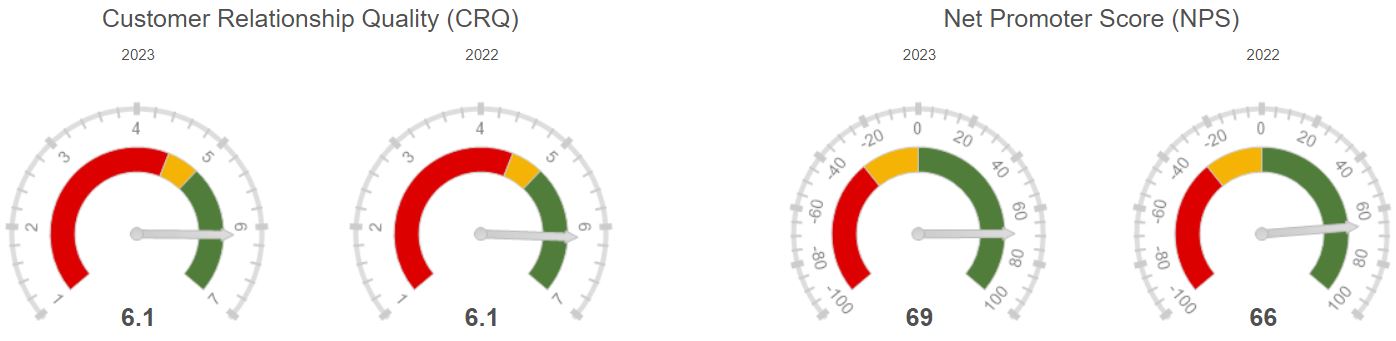
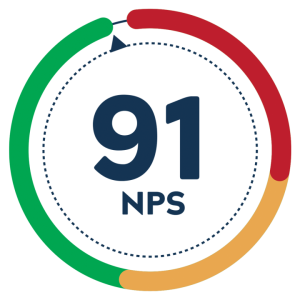
In summary: we received feedback from 85% of our customers, who gave us a CRQ score of 6.0 and a Net Promoter Score of +55.

NPS AND CRQ Deep Insight

We are incredibly proud of these scores and all the positive messages we received about our team.


Our greatest strengths are our exceptional team members
and their remarkable skills in forging enduring relationships
as CX consultants with our clients. Their dedication and expertise
truly set us apart. Big thanks to Fabienne Falvay, Kate Casey,
Fiona Lynch and Jade Flynn!


Our Commitment to Continuous Improvement

While we received a lot of positive feedback on our Products/Services, we are currently on a journey to explore how we can enhance our services and offerings. Navigating this change journey is a complex but rewarding endeavour.

We’re dedicated to discovering new opportunities for improvement and are eager to learn how we can better serve our customers.

How are we planning to do so?


‘Closing the Loop’ with our own clients.

The feedback process is not finished yet. We need to ‘close the loop’ with all clients and discuss their specific feedback. We will be in touch shortly with each one of our clients. We will be asking for time to discuss each client’s specific results and feedback.

Increase CRQ impact

Our customers appreciate the work we do, but they also see opportunities for CRQ to make an even greater impact across their organizations. We share this vision and are committed to enhancing our contributions. Over the past few months, our leadership team has spent significant time reviewing and refining our strategy, vision, and values. More details to follow on this, but in essence, our focus remains clear:

Deep-Insight – Providing innovative CX consultancy to global B2B organisations underpinned by a strong and competitive technical and data foundation.

We’re eager to explore how we can ensure this strategy delivers the maximum impact for your organization. Expect us to dive deeper into this topic during our “Close the Loop” sessions with you.

Before I conclude, I want to extend a heartfelt thank you to Jade Flynn for planning, organizing, and running this year’s client assessment. Jade joined us earlier this year and has quickly become an invaluable asset to our small but highly dedicated team. We’re grateful for her hard work and excited to see the continued impact she’ll make!

Alexandra Calugarici
Operations Manager, Deep-Insight

The B2B Blindspot: Why NPS Isn’t Enough

The B2B Blindspot: Why NPS Isn’t Enough


Why do so many B2B CX programmes fail?

Later this year, Bert Paesbrugghe will be hosting a LinkedIn webinar called The B2B Customer Success Blindspot: Why NPS Isn’t Enough. It sounds like it will be a good session and I have cheekily borrowed his title for this blog as it got me thinking about some of the reasons why B2B companies set up customer experience (CX) or Net Promoter Score (NPS) programmes in the first place.

More important, it’s worth reflecting on why these CX and NPS endeavours often fail to deliver on their initial promise. And that’s the sad truth – many of these programmes fail to improve the service delivered to customers. They don’t succeed for a variety of reasons. One of these is the belief that Net Promoter Score is a silver bullet for solving all manner of customer woes.

It’s not. That’s the blindspot. NPS is not enough for B2B companies.
B2B is different

The first thing to mention is that the Business-to-Business (B2B) world is VERY different to its Business-to-Consumer (B2C) counterpart.

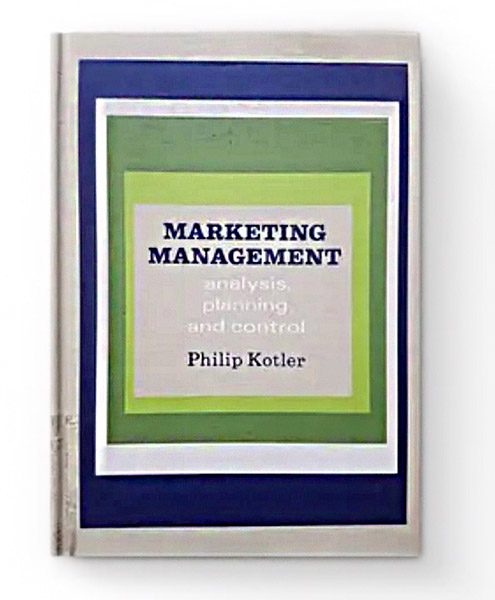
The consumer world is all about the 4Ps: ProductPricePlace and PromotionMarketing guru Philip Kotler popularised the 4Ps back in the 1960s. They were a core part of his Marketing Management book that many of us still have on our shelves today.

My only real problem with the 4Ps model is that it’s essentially a B2C concept. It doesn’t cover the subtleties of the B2B world where very often a service provider is delivering a very complex service across multiple locations – often in different countries. This is a world away from selling and marketing consumer products such as Mars Bars or Mercedes cars.

The 4Ps also don’t take into account the need for key/ global account management or the associated challenges of building and maintaining relationships with multiple decision makers and influencers across large global organisations.


NPS is one-dimensional

Net Promoter Score has proven to be one of the most durable metrics in management, ever since its invention by academic and business consultant Fred Reichheld more that two decades ago. Reichheld’s basic premise was that you only need to ask one question in order to understand if a customer is going to stay loyal to you or not. The question is: “How likely are you to recommend us to a friend or colleague?”

Fred, an excellent marketeer, promoted the benefits of his Net Promoter Score (NPS) concept in publications like the Harvard Business Review. He then proclaimed its merits in his 2006 book The Ultimate Question. Since then, NPS has became a hugely popular metric for customer loyalty and customer experience.

I’ve written about NPS before and, in general, I’m a fan of the metric for both its simplicity and its popularity. Sure, it’s not perfect, as Professor Nick Lee points out. But then again, is there a perfect KPI for anything? Let’s agree that Net Promoter Score has its place and is worth measuring even if it is a little one-dimensional. 

So NPS is good, but much more is required, particularly in the B2B world with all of its complexities, peculiarities and challenges.


Why NPS is not enough (in B2B)

Let’s go back to basics here. B2B IS different. So let’s recap on what some of those differences are:

  • Customer Base. Consumer brands like Mars Bars and Mercedes cars are sold to millions of individuals. Three million sold every single day, in the case of Mars Bars. In contrast, we work with B2B clients that generate annual revenues of more than €1bn from fewer than 100 clients.
  • Value. A Mars Bar costs around €1.60 at the time of writing (let me know if you can source them cheaper!) while an outsourced IT contract can be worth €100m. Admittedly, a Mars Bar can be consumed in less than five minutes while a €100m contract might take five years to consume. But you get the picture: value and Value For Money are very different in the B2B and B2C worlds.
  • Marketing Strategy. We talked earlier about Kotler’s 4Ps. While the consumer world is all about Product, the B2B world is more around Service and Relationships. Even in today’s AI-enabled world, those services are still delivered by people. Relationship-building is a critical component of the marketing mix the B2B world.
  • Sales Focus. In the consumer world, merchandising and point-of-sale advertising are key. In the B2B world, far more emphasis is placed on educating the customer about features, benefits, return on investment, and so on. This is still mainly done through personal contact and relationships.
  • What to Maximise? The consumer world is about the transaction – promoting those Mars Bar at the point of sale, for example. Customer lifetime value (CLV) is rarely if ever mentioned in the consumer world. CLV is arguably the most important thing to maximise in the B2B world as it typically takes 2-5 years to recover the initial sales cost of a major multi-year contract win.
  • Buying Process. In a supermarket, buying a Mars Bar is a split-second decision. Even for a Mercedes, the decision can be quick. Clinching that 5-year outsourcing deal can and does take years from beginning to end. It also involves multiple decision-makers and influencers.
  • Buying Decision. In the consumer world, decisions are often made on emotion – hence the importance of brand and image. In the B2B world, we like to think decisions are made on rational grounds, based on cleary-defined evaluation criteria.


What else is needed?

Let’s assume we have just sold a 5-year outsourcing deal to a client and we are now in the onboarding or delivery stage of that contract. Yes, it’s useful to know if our client would recommend us to a friend or colleague. That’s the Net Promoter question, but is it enough?

Not really. Ideally, we need to know much more. For example, do our clients trust us now that we have started working for them? Are they committed to us for the long term? Are they happy with the service that they are now receiving? 

These are just some of the questions that we need to ask our B2B clients in a systematic way. We need answers at an aggregate level but we also need feedback at an account level. Contract A may be going swimmingly. Contract B may already be on the rocks (to continue the theme) but we might not know that if we are only getting aggregated client feedback.


Eliminating the blindspot: Customer Relationship Quality (CRQ)

An alternative to asking the one-dimensional NPS question is to view the customer relationship more holistically. That’s where Customer Relationship Quality (CRQ) fits in.

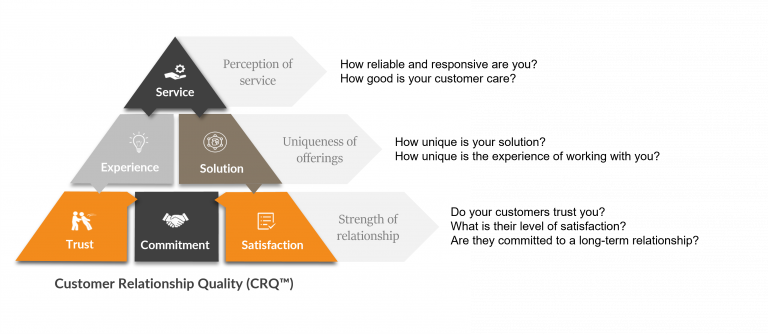
CRQ can be visualised as a pyramid comprised of three different levels.

  1. The first and most fundamental is the Relationship level. Do your clients trust you, are they committed to a long-term relationship with you, and are they satisfied with that relationship?
  2. The second is the Uniqueness level. Do your clients view the experience of working with you, and the solutions you offer, as truly differentiated and unique? Do they see us as good value for money?
  3. At the top of the pyramid is the Service level. Are you seen as reliable, responsive and caring? Get this wrong and you will never be seen as Unique and you will struggle to build a long-term relationship with that client.
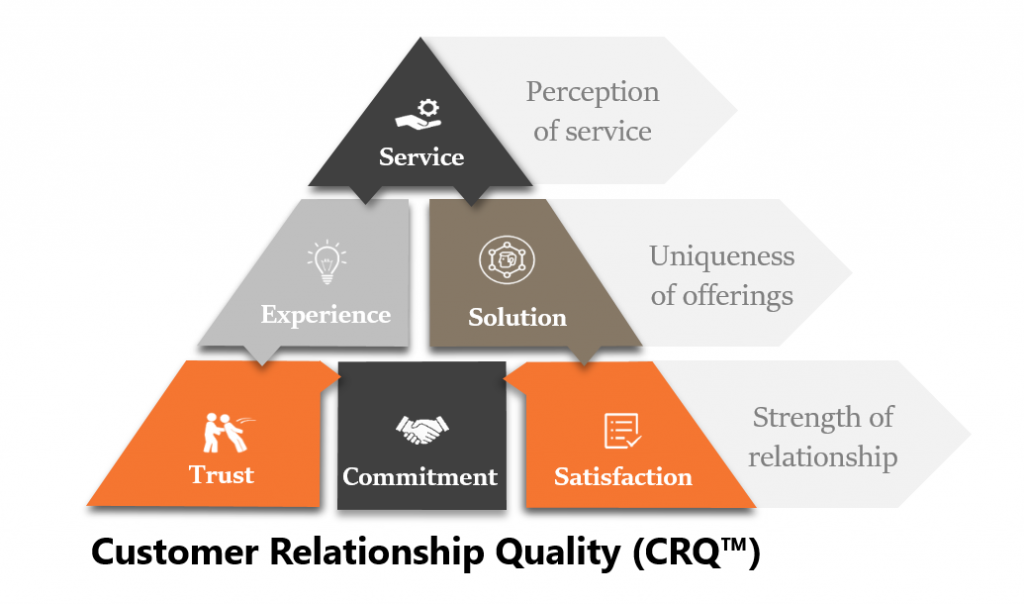
Interestingly, CRQ and NPS scores are highly correlated. If you score well on all six elements of this Customer Relationship Quality (CRQ) model, your clients will act as Ambassadors, generating a high NPS result for you. However, CRQ gives you so much more information to act upon, and that’s far more important.


The most important part: Action

The CRQ model above was specifically designed for the B2B world. That said, it really doesn’t matter what questions you ask your clients if you fail to do anything with their feedback.

The most important part of any NPS, CRQ, CX or client listening programme is the ‘Action’ piece. The reason that many  customer programmes fail to deliver is that they are run by the Marketing department (sorry guys and gals!) while the members of the company’s Senior Management Team have collectively washed their hands of any responsibility for acting on that client feedback.

In most B2B organisations, key client relationships are owned by Sales. In some cases where delivery is an ongoing function, it’s the Service or Operations functions that have most of the day-to-day client contact. It’s rarely, if ever, somebody from Marketing. The Sales Director (or Service/ Operations Director) needs to own the ‘Close The Loop’ element of the programme. It’s unfair to expect Marketing to take responsibility for it.

Put it another way: it’s madness to think that Marketing can effect change on its own. That’s a Leadership function. I’ve never seen a successful NPS ar CX programme that has not been driven from the top. So regardless of what you think of NPS as a B2B metric, don’t assume that NPS or any other set of survey questions is going to improve your top line or your profitability. It won’t, unless there’s follow-up action. That action needs to be managed systematically, and it needs to be driven by the  SMT or Executive Team.

Finally, do remember that it’s not about the score. It’s about using that valuable client feedback to take action and become more customer-centric. That’s how you generate more revenues and boost profits.


My new role as CX Product Manager: anyone up for a coffee and a chat?

My new role as CX Product Manager: anyone up for a coffee and a chat?

You may have had a peak at Rose’s blog from a few weeks ago regarding the results of our latest CRQ™ assessment. We received a ton of positive feedback from our customers, and it is clear they love what we do for them, so much so that they want more! 

So why am I re-iterating what Rose already shared in her previous blog? Well as part of Deep-Insight’s response to the 2023 CRQ feedback, a new role within the team has been announced: Product Manager

I am super excited and proud to share with all of you that I will be taking on the role of Product Manager at Deep-Insight!  

Who am I?

Some of you may know me from the projects we have worked on together over the past few years, but for those of you who do not know me yet, here’s a little bit about me: 

My name is Fabienne, I am originally from the Netherlands but have been living in beautiful Ireland for over 7 years now. I have been part of the Deep-Insight team for nearly 5 years and … I am a BIG fan of a good cup of coffee, so when it comes to my new role within Deep-Insight, this is exactly where I intend to start…. Coffee! 

I’m not being silly here, I actually do believe that it is key that I start my new role talking to you, our past, current and future customers. I want to understand more about how you see Deep-Insight and where you envision us to be in the next few years. How can we assist you further on your CX journey as well as in reaching your business goals? 

I am thrilled to be starting my new role in the next year and cannot wait to see what the future holds for Deep-Insight!  

I’ll be spending the first few months in my new role chatting about all this in more detail with many of you and can’t wait to get stuck in 🙂 

Please free to reach out to me directly if you have some thoughts/ideas you’d like to share! 

Cheers,

Fabienne
fabienne.falvay@deep-insight.com

Fabienne Falvay

We have a fantastic NPS score, again! – but its not the full story

We have a fantastic NPS score, again! – but its not the full story

Great News

We are genuinely delighted to announce that our NPS (Net Promoter Score) and CRQTM (Customer Relationship Quality) scores are fantastic, again! Stifle that yawn – I promise it gets more interesting. 

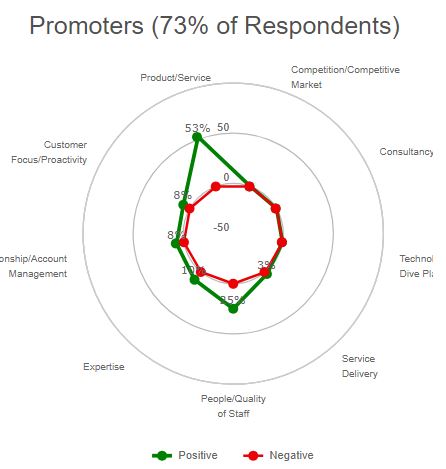
We are very proud of this picture. Most of our customers are promoters – they love our products and services and are willing to tell the world about it. Time to celebrate and shout this from the rafters – right?

Call it intuition or call it 20+ years’ experience in understanding client feedback but far more digging into the feedback would be needed before we were ready to celebrate.

The result of this digging is the creation of a new role – Product Manager – and their first objective will be to validate if we have the correct product strategy

So, how is this logical given the amazing feedback that I have just shared, especially around product? The answer to that is a lesson on why you should never just rely on NPS to tell you how your customers are feeling or what their future intentions might be.

Lets start digging.....

This is where CRQ really helps us to get under the bonnet of even the rosiest feedback, forcing us to listen to the murmurs of bubbling discontent.

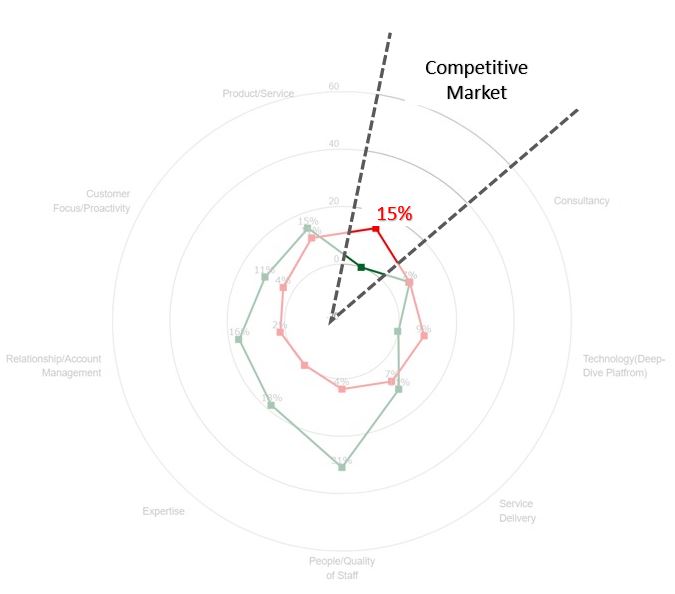
The first red flag is when we asked all respondents what our greatest weakness is, not only did we have a new winner – we had a new topic entirely and it was mentioned by 15% of respondents.

Is this really a problem?

Immediately the internal arguments came that this was a blip and not that important. Arguments we used to try and convince ourselves were:

  • 15% is still not that many!
  • Price (often a key indicator of competitiveness) is not raised by even one respondent.
  • We are in the CX business for over 20 years (long before CX was even a thing) – you will find it difficult to find a competitor in the B2B space with more global, cross industry, experience than us.
  • Just look at that promoter graph again, our customers love us!

The only way to answer these arguments is to establish if there are further data insights that support this feedback? (Keep Digging)

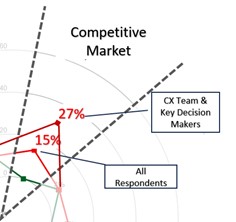
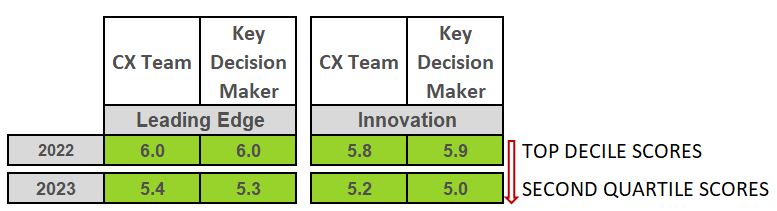
We started by segmenting the feedback into the respondents who know us best – the CX Teams we work with every day and Key Decision Makers who repeatedly choose us as their CX Partner.

Turns out that even a higher percentage of the individuals who know us best believe this to be a weakness for us.

Further investigation of CRQ™ scores only compounded that we need to listen. Focusing again on those individuals who know us best, scores that link closely to this type verbatim have slipped from Top Decile Scores to Second Quartile Score .

The important Insight from all this data

🙂 Great overall scores are not wrong – Our customer love what we do and how we do it.

But here is what we cannot ignore

🙁 Our customers want more CX services than we currently offer, and they perceive that there are other suppliers in the CX space now who can give them what they want.

😐 Some of our customers also believe that other CX suppliers are better at promoting themselves in the market and raising brand awareness.

The exciting part of all of this

🙂 Our customers do not want to use those other suppliers; they trust us and believe in our integrity as their CX Partner. They want us to provide these additional services, and they want us to tell the world how great we are.

The Action - A new position in Deep-Insight: PRODUCT MANAGER

FIRST OBJECTIVE: Validate if our current product strategy is correct, needs to be tweaked or needs a massive overhaul. 

FIRST STEP: Ask many customers, previous customers, industry contacts and friends for your input and I will be extremely grateful to anyone who can give us the time to help

PURPOSE: Change, even if that is in a way that neither us nor our customers can predict just yet 

P.S. I am not ignoring the brand promotion and awareness feedback, our CEO John O’Connor is going to take personal ownership of addressing this. Watch this space, his thoughts will follow shortly.