DWF is a global legal firm based in Manchester. We kicked off a new Key Account Programme with them last week. I’m delighted to be involved as it’s the first time Deep-Insight has helped a major international law firm establish a programme like this.
Don’t get me wrong. We have set up hundreds of programmes like this in other sectors. What’s exciting about this one is that DWF is one of only a few legal firms to establish such a comprehensive international programme.
I’m really looking forward to working with Karen Lees and her team on this!
Fabienne Falvay
Project Coordinator, Deep-Insight
********************
Deep-Insight and DWF partner on new Key Account Programme
Cork, 10 March 2020
Deep-Insight is delighted to partner with DWF on a new Key Account Programme. DWF is a global legal business headquartered in Manchester in the UK. It supplies services to the global legal market. It also provides complementary connected services to its clients. DWF’s purpose is to transform legal services through its people for its clients using three principal strategic objectives:
– understanding clients;
– engaging people;
– doing things differently.
Karen Lees is Head of Clients at DWF and has overall responsibility for success. “We are delighted to launch this new and improved client feedback programme. The new approach enables us to gather feedback from our clients globally. More important, it allows us to analyse the trends and act upon the findings. In line with best practice, we will be gathering both qualitative and quantitative data about our clients’ experience with us. Introducing an effective client feedback process ensures we have robust practices in place that allow for a measurable and scalable client-focused strategy.”
John O’Connor, CEO of Deep-Insight adds: “It’s an honour to be working with the UK’s largest listed law firm. DWF is also one of the most innovative legal firms, having been ranked 11th in Europe by the Financial Times. Today, DWF is more than just a UK law firm. It has already completed 15 acquisitions and has transformed itself into a global company operating across 14 different jurisdictions. This new Key Account Programme will help DWF understand how each client feels about its relationship with the firm.”
********************
About Deep-Insight
Deep-Insight is a leading European B2B Customer Experience (CX) company. It was founded in 2000 by a small team of ‘magicians’ with one goal: researching a way to read customers’ minds. Deep-Insight is headquartered in Cork, Ireland and has sales operation in the UK, Netherlands and Australia.
About DWF
DWF is a global legal business providing Complex, Managed and Connected Services. It operates from 33 key locations with approximately 4,300 people. DWF became the first Main Market Premium Listed legal business on the London Stock Exchange in March 2019. DWF recorded revenues of £272 million in the year ended 30 April 2019. For more information, visit the website.
U P D A T E : I originally wrote “Who is Kim and where is she based?” in February 2020 just after Atos restructured itself into market-facing units. In June 2022, Atos announced that it was looking into an even more fundamental restructuring of the business. If the plan gets approval, a brand new company called Evidian will be spun out of Atos.
* * * * * * * * * * * * * * * * * * * *
Becoming more Customer-Centric
Don’t be confused by the title. This is actually a personal blog post about global organisational structures and why companies sometimes change them to serve the customer better. It’s about becoming more customer-centric. Honestly!
What triggered me to write this blog was today’s announcement of a new global organisation structure for Atos, a client of ours and a true leader in the IT and digital world. Atos is also a great case study in how leaders change their organisation to become more customer-centric.
Atos Announcement
Today, the new CEO of Atos Elie Girard announced a major global restructuring of its operations. You need to read between the lines to figure out how dramatic this change actually is. No longer will counties the UK, France, Germany and other countries be responsible for their own P&Ls. These will now be run by six global industry heads. The axis of power will shift and the shift is seismic.
Paris, 19 February 2020
Moving the Group to an Industry approach
As of 2020, the Group initiates a transformation, called “SPRING”, aiming at reshaping its portfolio of offerings, reinforcing its go-to-market approach, and setting-up an Industry led organisation. In this context, six Industries are created:
– Manufacturing
– Financial Services & Insurance
– Public Sector & Defense
– Telecom, Media & Technology
– Resources & Services
– Healthcare & Life Sciences
At the same time, the Company gathers Global Business Units into 5 Regional Business Units (RBU), each of them under a single leadership:
– North America
– Central Europe: former Germany, and Central & Eastern Europe excluding Italy
– Northern Europe: former United Kingdom & Ireland, and Benelux & The Nordics
– Southern Europe: former France, Iberia, and Italy
– Growing Markets: former Asia-Pacific, South America, and Middle East & Africa
Why?
It all sounds a bit complicated: GBUs, RBUs, Industries and so on. And yet Atos is moving to this new organisation structure in order to become more customer-centric. Here’s why.
Atos’ customers are typically large international organisations. To serve them better, Atos needs to move to a more global organisation structure, with deeper industry skills that can be deployed across international boundaries for the benefit of those clients. If your clients are global, you need to be global. This change is absolutely the right thing for Atos to do. That said, there will be challenges along the way. I’m only saying this because of personal experiences in a previous life.
Execution
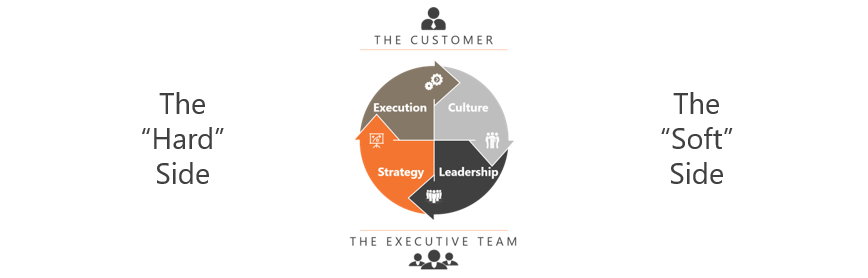
Becoming more customer-centric requires four elements to be in place: Leadership, Strategy, Execution and Culture.
Atos has shown leadership and determination in making such a significant restructuring of its business. That leadership has driven a new strategy for delivering more effectively to global clients. Profit & Loss will no longer reside in each country. It will reside in an Industry or Global Business Unit (GBU). Now Atos is in the Execution phase. This is where the new organisational structure must work for both clients and employees. If Atos gets this right – and I’m sure it will – the culture of the new company will be changed utterly. And that’s good for Atos’ clients. The trick in the Execution phase is to involve both customers and employees in transformation. In other words, don’t just think of Execution in terms of ‘hard’ activities such as processes, technology, targets and KPIs. The human side of the equation is arguably more important. We call this Investing in the “Soft Side”.
A Personal Experience
More than 20 years ago I used to work in Andersen Consulting (since rebranded as Accenture) at a point when it was moving from a country-based organisation structure to a global GBU structure just like Atos is now doing. It was a painful experience for a number of reasons but – no different to Atos – it was absolutely the right thing to do. Accenture’s clients were large global organisations and that required Accenture to become a truly global organisation as well.
More than 100,000 Atos staff are now going through the very same restructuring process as I did all those years ago. For most, the impact will be small; for many it will have a significant impact on their lives and careers. As for Atos itself, the impact will be transformational.
So here’s a small personal perspective on what it’s like to be a small cog in a large wheel going through a global organisation restructure. In the late 1990s I was working with Accenture in Dublin, having transferred from its London office a few years earlier. My boss in Dublin was a guy called Mark Ryan. We both worked in the Irish Financial Services practice – our clients were the local banks and insurance companies. When the new organisational structure was announced, Mark called me in to his office. He said: “John, you’re no longer working for me. We’re now part of a European group within Financial Services. Your new boss is Kim Zimmer.”
Who the Hell is Kim and Where is She Based?
I don’t remember my exact response but it was probably something like “Who the hell is Kim and where is she based?” Mark laughed. At the time, I didn’t really see what was so funny.
After a while, Mark stopped laughing and said “Kim’s actually a guy. And he’s based in Oslo.”
As it turned out that Kim Zimmer was a wonderful man. Kim and his fellow partners had built a great business for Accenture in Norway based on long-standing relationships with senior leaders in the local banking and insurance community. For me, it was a great opportunity to work in a more European role (and spend more time on a plane). The European aspect of the work was great but the time spent in airports and hotels eventually got to me. A few years later I resigned from Accenture after a wonderful 13 years in what was always a very international company. I ended up in Deep-Insight where I’m still travelling but on a more manageable basis.
Footnote
I was going to name this blog “Who Do I Need to Buy Drinks For?” One of the most important aspects for anybody in a large multinational company is knowing who to talk to in order to help you develop your own career. Mentoring is important in any large organisation and organisational changes disrupt the linkages that people build up over time. It’s something that senior managers need to bear in mind when they suddenly find themselves with a brand new team of people reporting into them. Being customer-centric also means being employee-centric.
Similarly, for staff, it’s important to get facetime with new bosses. You don’t need to ply them with alcohol but it is important to engineer the opportunity to spend time with them to understand what their motivations are and how you fit into their plans.
Peter Whitelaw and I wrote a book last year called Customer at the Heart. It was a fun experience interviewing CEOs and sales directors from large B2B companies across Europe and Australia.
One of the consistent messages we heard in those interviews was the importance of investing in the ‘Soft Side’. In other words, focusing on people as much as on process.
This is a really important point: if you are responsible for running a customer experience (CX) programme in your organisation, don’t under-estimate the importance of investing in ‘Soft Side’ activities if you want to generate real long-lasting results.
This means spending significant amounts of time with both your leadership and client-facing teams planning for success.
The Importance of Investing in the ‘Soft Side’
A quick recap on the four quadrants in the Customer at the Heart model before we go any further:
1. LEADERSHIP. The most important quadrant. Good Customer Experience (CX) programmes are ALWAYS led from the top
2. STRATEGY. Good CX programmes link customer, product, operational and organisational strategy explicitly to customer needs
3. EXECUTION. Success requires properly resourced CX teams that are brilliant at executing the Strategy
4. CULTURE. Finally, Customer Excellence must become integral to the DNA of the organisation: “it’s how we do things around here”
All four quadrants are necessary for a successful CX programme. The ‘Hard Side’ quadrants of Strategy and Execution are all about metrics and processes. ‘Hard Side’ activities lend themselves to key performance indicators (KPIs) and while the activities in these two quadrants are important and easily measurable, the quadrants of Leadership and Culture are actually more critical.
In our experience, Leadership is the most important quadrant while Culture is the most challenging. And yet, here’s the strange thing: in most CX programmes the ‘Soft Side’ is often overlooked and almost always under-resourced.
Our Approach
We have a different approach at Deep-Insight. We spend a lot more time with leadership teams and sales or account teams BEFORE we think about asking our customer’s clients for their views. If you want to run a customer survey in a hurry – “I need to get the results back by the end of the month…” – we’re probably not the organisation for you.
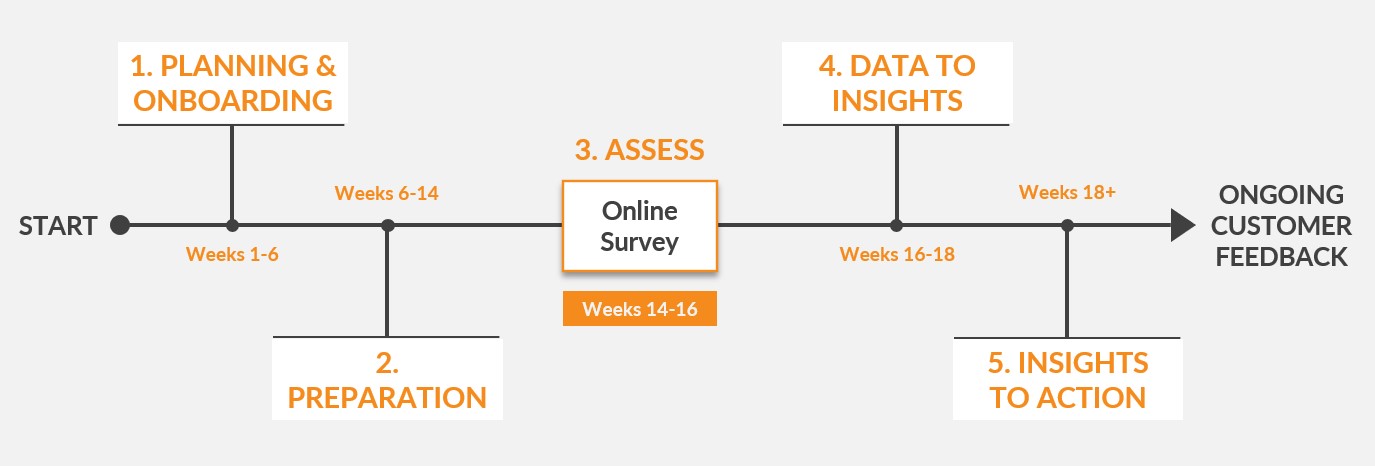
At Deep-Insight, the first 14-16 weeks of our process are critical and must be done properly. If you don’t invest the time up-front, your CX programme will not deliver the results that Management and the Board expect from it. More than likely, it will end in failure. It’s as simple as that.
Planning & Onboarding
The first phase in our approach is ‘Onboarding’ the organisation; The very first step is to secure the buy-in from the senior leadership team to the journey that they are about to embark on. And it is a journey because cultural change takes time. The second step is to onboard the rest of the organisation, primarily the sales and account teams. They own the customer relationships and if they don’t embrace the programme with gusto, the entire programme is at risk of being seen as a box-ticking exercise.
We typically work with dispersed sales and service teams in online workshops, and always with senior leadership support and involvement. These onboarding workshops are critical to driving up response rates and completion rates, as well as delivering action and improvements.
Insights to Action
The final phase is where the rubber hits the road. The online survey is complete. We have gathered some key insights from the feedback. Now it’s time to assemble the sales and account teams again. This time the focus is on their role in ‘Closing the Loop’ with the client. This is arguably the most critical part of the entire process. The account manager – sometimes with a member of the senior leadership team – must meet the client to discuss the feedback from all individuals in that client’s organisation.
In many cases, these discussions are straightforward because everything is fine and the relationship is on an even keel. In some instances, the client may be a ‘Stalker’ or an ‘Opponent’ and a much tougher and more honest conversation is needed.
The key outcome of these ‘Close the Loop’ meetings is agreement on the appropriate actions that are needed to improve and deepen the relationship. This gets built into the Account Planning process for that client.
Investing in the ‘Soft Side’
If your CX programme isn’t working the way you hoped it would, it’s probably because you’ve under-invested in the Leadership and Culture quadrants. The symptoms will be clear: disengaged account teams; limited insights; complete absence of action.
If you notice any of these symptoms in your CX programme, do get in touch.
I’m delighted to be working with Arun Bala, Nitin Lalan and the Invenio Business Solutions team on this great programme.
I’ll let you know later in the year what we are achieving together at Invenio. For now, here’s the official announcement of our partnership with Invenio!
Shane O’Regan
Project Coordinator, Deep-Insight
Invenio announces partnership with Deep-Insight
Cork, 24 January 2020
Deep-Insight is delighted to announce its partnership with Invenio Business Solutions. Invenio is a global leader in solving business challenges with IT solutions. This tailored programme will enable Invenio to better understand customer needs, address concerns, and implement measures to enhance relationships and the customer experience itself.
Invenio has doubled in size since 2017 and anticipates more growth in the coming years. Invenio’s leadership team recognises the business’s rapid growth, including the need to maintain core values while evolving the organisation’s culture as it matures.
Invenio’s new Customer Experience Programme will be insight-orientated and action-orientated. ‘Customer Focus’ will be at the forefront. The programme will facilitate interventions as soon as customer issues arise, and ultimately becoming key to the annual account planning process. This investment is integral to all future activities at Invenio and is a tangible commitment to integrate the customer voice across global business units.
Deep-Insight’s approach is multifaceted. It is based on the view that to achieve a truly customer-centric organisation requires a roadmap of careful planning and execution. The annual in-depth assessments will identify gaps and help build lasting customer relationships with personalised plans across each account.
At Invenio, listening to customers and strengthening relationships is imperative to delivering exceptional experiences. Ultimately, this will help Invenio achieve its core purpose of being the most trusted and valued partner in its customers’ success.
Partnership
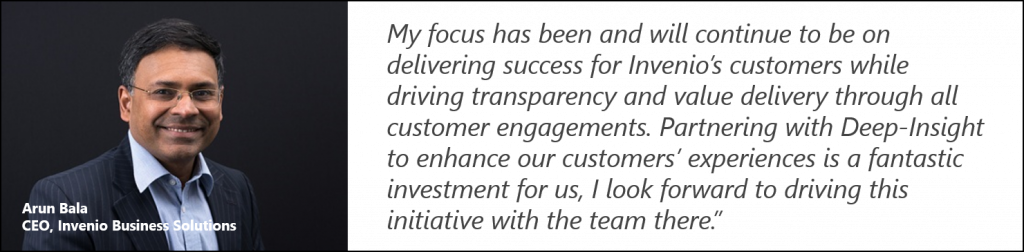
Arun Bala, CEO at Invenio commented: “My focus has been and will continue to be on delivering success for Invenio’s customers while driving transparency and value delivery through all customer engagements. Partnering with Deep-Insight to enhance our customers’ experiences is a fantastic investment for us. I look forward to driving this initiative with the team there.”
John O’Connor, CEO at Deep-Insight: “We’re delighted to come on board and support Invenio on its Customer Experience journey. We’re looking forward to employing the skills, tools and Customer Relationship Quality methodology to help Invenio employees operate a world-class Customer Experience Programme.”
KPN is a leading telecommunications and IT provider and market leader here in the Netherlands. As well as supporting several million consumers, KPN also supports corporate customers in the areas of infrastructure, workplace management, the cloud, security, data networks and data centres.
Our CEO John O’Connor recently caught up with René Versluis, who has been responsible for running the Net Promoter Score (NPS) programme at KPN’s corporate division for several years. René is a genuine expert in running a customer feedback programme in a large corporate business to business (B2B) environment.
I hope you enjoy this short interview with René Versluis.
Pim Braat
Deep-Insight Regional Manager, Benelux
_________________________
René Versluis and NPS
John: René can you tell me a little bit about yourself and your involvement with Net Promotor Scores (NPS)?
René: Sure, John. I have worked with KPN for more than 15 years and I have had a series of commercial and sales roles during that time. In recent years, I have been a programme director for some of KPN’s strategic projects including responsibility for setting up and running its Net Promoter Score (NPS) programme for corporate clients. The trigger for KPN creating that role and asking me to take ownership was the fact that KPN values its corporate clients and is interested in their feedback in the fast developing world.
The Importance of Good Governance and Follow-Up
John: What were the first things you did when you took on this new role?
René: Leadership is important so my very first step was to create an NPS board which included many of the senior leaders in the company. We met initially every single week. This was an important step in setting the right governance for the programme.
John: Would you say that the NPS programme was successful?
René: Yes, I would say we had a lot of success with the NPS programme. We got feedback from customers but more important, we took action. If a client score needed to be improved, we implemented a Client Improvement Plan. We also insisted on closed loop feedback with each client. That means that within four weeks of a survey taking place, the account director created this Client Improvement Plan and discussed, agreed and shared that plan with the client.
Lessons Learned
John: What lessons did you learn from running the programme? Or to put the question a different way, what advice would you give to yourself if you were to start all over again?
René: I don’t think I would have changed anything fundamentally. I have mentioned the importance of leadership. The other thing that is important is setting realistic targets. You can’t change the culture of an organisation if you set targets that are not achievable.
John: How did the NPS Board change the culture in the organisation to make it more customer-centric?
René: One of the techniques that we used when people came to us with a proposition was to ask them: “What is the effect of that on the NPS score?” If you keep asking that question, eventually people recognise that any proposal or any investment needs to be made with the customer in mind. If it’s not and people can’t articulate a clear benefit for the customer, then it’s a wasted investment. I would also say that you need to work very closely with key clients – you can’t assume that you have the right answer. You must make sure the client thinks it’s the right answer.
The Future
John: You’ve recently left KPN after more than 15 years. What do you plan to do now?
René: I’m not ready to retire just yet! I think I have learned enough from my time at KPN to help other companies thinking about embarking on their customer experience of NPS programmes. Net Promoter is a great tool but it needs to be applied correctly in B2B environments.
John: The very best of luck, René, and thanks again for sharing those insights with us.

 Hello. I’m Fabienne.