Win/ Loss Reviews


The Importance of Win/ Loss Reviews

Here’s an uncomfortable truth: most B2B organisations don’t really know why they win or lose deals. They think they do. They have dashboards, CRM reports, pipeline analytics, and conversion ratios sliced and diced every which way.

But those metrics only answer one question: What happened. They do almost nothing to answer the far more important question: Why did it happen? 

And without understanding the “why,” all that impressive data is little more than expensive guesswork.

The Illusion of Insight

Most sales directors can recite their sales funnel numbers:

  • How many leads become qualified opportunities
  • What percentage reach proposal stage
  • What proportion of bids convert to a sale

Track these numbers over time and you can diagnose whether the issue is demand generation, qualification discipline, or closing effectiveness. CRM systems make this much easier today than in the past. In theory, at least.

In practice, data quality is uneven, sales teams prioritise revenue over administration (in other words, don’t count on the sales team to keep your CRM system up to date) and many organisations rely on Sales Operations or Revenue Operations functions to maintain order.

Today, sales leaders are quite good at measuring performance. They are far less equipped to explain it. They can tell you the company’s win rate dropped from 32% to 27%. They usually cannot tell you why.

A Discipline Hiding in Plain Sight

What makes this particularly frustrating is that the solution is not new. The solution — Win/Loss Reviews — have existed for over fifty years. Back in the 1970s, defence contractors and other large B2B firms involved in massive government bids began conducting rigorous post-bid reviews. They understood something many modern businesses still overlook:

A tiny improvement in win rate can deliver enormous revenue impact over time.

They didn’t call it “Win/Loss analysis” in those days — that terminology only became common in the 1990s — but they had already grasped the principle: If you want to improve outcomes, you must systematically learn from them. 

Yet despite decades of awareness, most organisations still treat Win/Loss Reviews as an occasional, informal exercise rather than a core business discipline.

Win/ Loss Reviews are Rare

One of the most influential book on the topic remains Win/Loss Reviews: A New Knowledge Model for Competitive Intelligence by Rick Marcet.

When Marcet, an American sales veteran with three decades of experience in technology sales, wrote the book in 2011, his central finding at the time was somewhat sobering:

Fewer than 10% of sales opportunities are ever reviewed with real rigour.

Even more striking, he observed that fewer than 5% of companies had any formal win/loss discipline at all — and those that did typically focused only on losses.

A decade and a half later, the numbers have improved slightly — but not dramatically. It’s hard to get definitive figures but the research suggests that even in large B2B companies – we’re talking enterprise organisations with annual turnovers of €1bn or more – as few as 10-25% of deals are reviewed rigorously.

That’s low. And it’s even lower for mid-market and SME companies, as the table below illustrates.

Factor

Large Enterprise

Mid-Market/ SME

Dedicated function

Yes (Sales Ops / Revenue Ops)

Rare

Formal process

Common

Limited

Data infrastructure

Advanced

Basic CRM

Cultural maturity

More analytical

More relationship-driven

% deals reviewed rigorously

10–25%

3–10%

In other words, even among large, sophisticated organisations, systematic learning from sales outcomes remains surprisingly rare. One of the biggest barriers to a wider adoption of systematic Win/Loss Reviews is cultural. We’ll discuss that shortly.

Relationships: The Reason Many Bids are Won or Lost

B2B organisations pride themselves on relationships. And rightly so — trust and credibility remain central to complex sales. Building strong relationships is probably still the best way to win bids. It’s certainly the cornerstone of renewing contracts, as I’ve discussed in previous blogs.

But Marcet offered a provocative warning that still resonates:

“An overreliance on relationships may actually mask mediocrity and underperformance in other areas.”

This is where many organisations get into trouble. Yes, strong relationships can win business — but they can also create dangerous blind spots. Teams assume they understand customers because they know them personally. They attribute losses to price pressure or procurement tactics instead of deeper issues.

The truth is that deals are almost never won or lost for a single reason.

What Really Drives Win/Loss Decisions

Proper Win/Loss reviews consistently reveal a far more complex picture. Relationships are critical but there are other factors at play too:

  • Product fit — The proposed solution may not fully address the client’s real priorities.
  • Perceived value — Price is rarely the sole issue; buyers weigh risk, confidence, and expected outcomes.
  • Competitive positioning — Reputation, differentiation, and credibility often matter more than features.
  • Service capability — Past delivery performance frequently determines future buying decisions.
  • External factors — Budget changes, mergers, strategy shifts, or regulation can override everything else.

Without direct customer feedback and proper analysis, these drivers remain largely invisible.

The Myth about Learning from Losses

Another persistent myth is that organisations learn more from losing than winning.

In reality, wins often provide richer insights. Understanding why a customer chose you — what tipped the decision, what risks they perceived, what nearly derailed the deal — provides powerful guidance for future success.

Both wins and losses are fertile ground for learning.

Ironically, organisations often focus almost entirely on losses — missing half the available insight.

Fewer than 5% of companies apply any formal win/loss review discipline to their sales outcomes, and those that do usually focus only on the losses.”


Interviews versus Surveys: Depth vs Scale

One reason why companies avoid rigorous Win/Loss Reviews is cost.

Independent buyer interviews can cost anywhere from €700 to €1,500 each. They require skilled moderation, recruitment effort, and structured analysis.

But the depth of insight they generate is unmatched. Seasoned sales professionals like Cian McLoughlin at Trinity are experts at conducting these in-depth interviews. As Cian says:

“For win-loss analysis to be truly effective, you’ve got to venture beyond surface-level feedback, to the hard truths that lie beneath. Customers will rarely volunteer this information, unless they believe you’re serious about taking action.

Surveys offer a cheaper alternative and allow broader coverage — but typically suffer from lower response rates and more superficial feedback.

The most effective Win/Loss programmes will often combine both: surveys for scale; interviews for depth.


Why are Win/ Loss Review so Rare (and Where to Start)

The biggest barriers are not technical — they are cultural.

  • Sales teams fear blame.
  • Leadership attention moves quickly to the next quarter.
  • Ownership of insights is often unclear.
  • Learning from outcomes requires discipline and persistence.
  • As a result, Win/Loss Reviews remain ad hoc rather than institutionalised.

The good news is that organisations don’t need a large budget or complex infrastructure to begin.

Start by interviewing a small number of recent customers — both wins and losses. Even a handful of structured conversations can reveal patterns that internal teams never see.

Over time, these insights can influence strategy, messaging, product development, and sales effectiveness. In competitive B2B markets, even a modest increase in win rates can generate significant revenue gains.


One Final Thought

We know Win/Loss Reviews are not new. We know they are not complicated. Their value is not debated. Yet most organisations still fail to do them properly. Why?

Perhaps the real reason is this: They force businesses to confront uncomfortable truths about how they are perceived by customers. And that can be harder than building another dashboard.

But for organisations serious about improving performance, there are few more powerful — or more underutilised — sources of insight.

Contact us at Deep-Insight if you want to find out more about setting up Win/Loss Review programmes.

Susan and Bill have Relationship Problems! (Part III)

The last time we met Susan and Bill, they were discussing survival tactics. Thankfully, they have managed to get the company back on an even keel – excuse the boating pun – over the past few months and now have a new challenge to face: becoming a ‘Unique’ company.

At the last board meeting, the CEO (an avid sailing enthusiast) asked them to prepare a strategy that would transform the company from an ‘Even Keel’ company to becoming the best in the marketplace.

“I don’t want us to be competing on price. I want us to be seen by our clients as leading edge in the market, innovative, really easy to do business with. Now it’s up to you two to make that happen. Get back to me by 23 September with a strategy for making this company ‘Unique’. And it better be good.”

Unfortunately, Susan and Bill are at loggerheads trying to plot a course towards that ‘Unique’ organisation that their CEO so desperately wants them to become.

EPISODE III: Becoming a ‘Unique’ Company

Susan – Sales Director

“Uniqueness is a simple sales concept. Uniqueness = More Sales. It really is as simple as that. We can become Unique if Bill and the product development team provides me with market-beating products. That’s the thing they can’t seem to grasp.”

Bill – Marketing Director

“Becoming Unique is a complex brand concept. It’s how you are seen vis-à-vis the competition. We’re a services business and the differentiating factor is the quality of our service and account teams, not the products. That’s what Susan fails to grasp.”
Susan’s view is (as usual) very simple: “Give me decent products/services and I’ll sell them. If the products/services are unique, we’ll sell more of them. It’s not really my job to DESIGN them, so don’t go asking me about transforming this company into a unique organisation.”

Bill has a slightly more nuanced view. He accepts that it’s his job to translate customer needs into the sorts of products and services that the clients will love and buy, but he also makes the valid point that he and Susan are in a B2B services business. That means that Susan’s account teams (as well as the Service/Delivery teams) have a key role in crafting a Unique solution and experience for her clients.

Bridging the Gap

As usual, Bill is half-right. And so is Susan.

But let’s start by bringing a little clarity on the terms we are using. Let’s begin with a definition of what ‘Unique’ means in the B2B world.
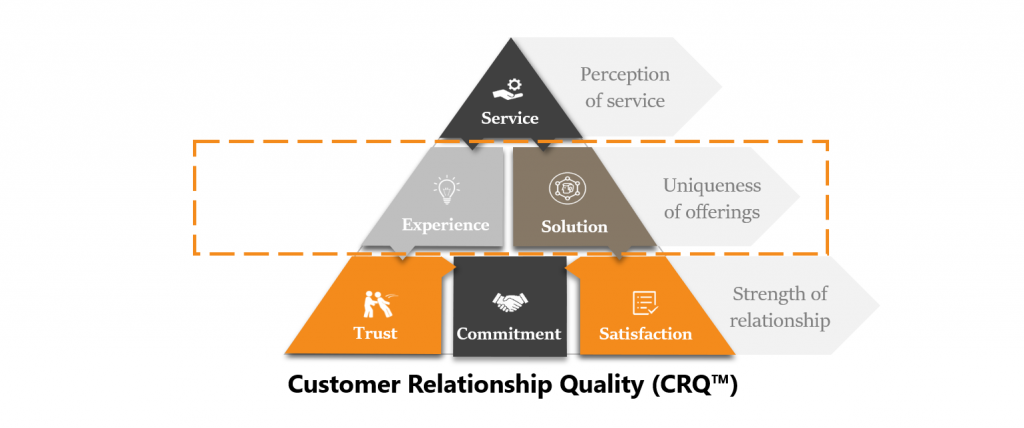
Uniqueness
In the B2B world, Uniqueness means that your clients have a fantastic Experience working with you, and that you provide a world-beating Solution for them.

Experience is a measure of how easy you are to do business with and if your clients see you as a true business partner that is critical to their success. You can have the best products or services in the world but if your clients can’t work with you, they won’t see you as a true business partner.

Solution is a combination of innovationleading edge and value-for-money. These are three related but slightly different concepts. If you get good scores for all three, the chances are that you have an offering that can help your clients improve their standing in the marketplace in a way that none of your competitors can provide. When we talk about Solution we’re not just talking ‘product’. As Bill says, it’s as much about how the account managers, sales and delivery teams position your company’s product or service, as it is about the product/service itself.

Is your company ‘Unique’?

So when Bill and Susan’s CEO talks about wanting to be a Unique company, he’s really talking about building a B2B brand that excels at all the different elements that we group under the headings Solution and Experience. And that means the Bill and Susan need to work together to get all those elements right. But as the methodology above shows, you can’t build a unique B2B brand without having an excellent service to underpin it. So Bill and Susan and going to have to rope in the Operations Director as well. We wish them well on their journey.

Ultimately, the answer to the question about whether your company is Unique will be dictated by your customers. But you’ll never know if you don’t ask them.

Contact us if you want to find out.